Table of contents
Imagine a structure so massive it can affect the rotation of the Earth. Now imagine a newer project, even bigger—not just one dam, but an entire network of power flowing across a continent. That’s what China is building today. And it’s more than just an engineering marvel. It’s a signal that the way we power our lives is changing, fast—and it’s rewiring millions of lives in the process.
From the Dam That Slows Earth’s Spin to Something Even Bigger
You’ve probably heard of the Three Gorges Dam. Located along the mighty Yangtze River, this mega-structure has long been China’s most iconic hydroelectric achievement. With a massive capacity of 22.5 gigawatts, it’s huge enough to influence Earth’s rotation ever so slightly—by shifting water mass in such a concentrated way, it nudges the planet’s balance.
But that wasn’t the end of the story. It was only the beginning.
Today, China is rolling out a new system of mega-dams deeper into the country’s remote west. These aren’t just standalone projects. They’re part of a vast, connected vision—dams that work hand-in-hand with ultra-high-voltage (UHV) power lines to move electricity thousands of kilometers across the country.
One Giant Grid: Power from Rivers to Cities
China’s latest plan treats the whole country like one carefully tuned energy machine. The idea is simple: generate clean power where nature allows—in western China’s windswept mountains and icy valleys—and send it to the energy-hungry east. Places like Shanghai, always on and always glowing, get powered from rivers miles away.
Key projects include:
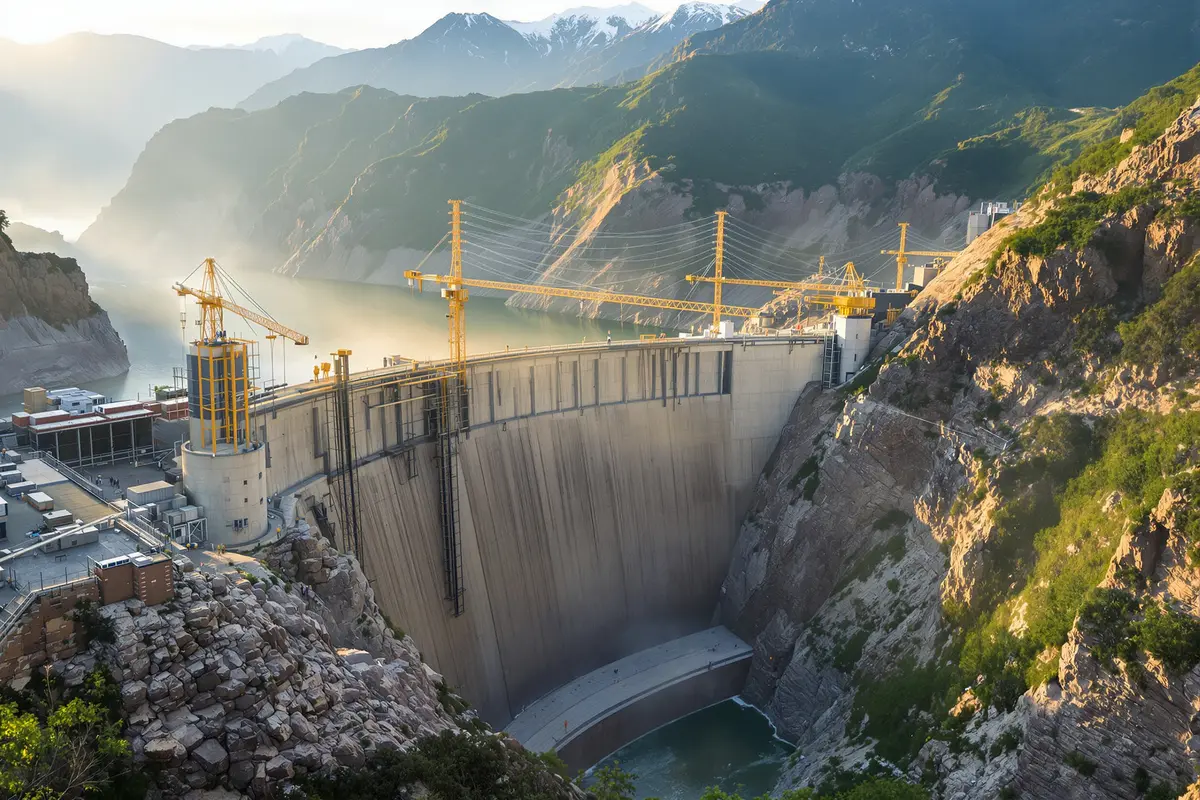
- Baihetan Dam: One of the new giants on the Jinsha River
- Wudongde Dam: Another massive hydro plant woven into the same corridor
- UHV lines transmitting power at up to 1100 kilovolts with minimal loss
It’s like building a continent-spanning extension cord—clean, quiet power flowing at night through desert, mountain and farm, straight to a phone charger in a distant apartment.
Clean Energy with Complicated Trade-Offs
This new era of hydropower could reduce China’s reliance on coal significantly. And when combined with enormous wind and solar fields in places like Xinjiang and Inner Mongolia, the country gets closer to a green energy future.
But here’s the tricky part: not all impacts are visible from the control room.
When these dams are built, valleys flood. Villages move. Cemeteries and farmlands can vanish forever. To a planner, this might look like numbers in a report—“resettlement ratios,” for instance. But to a farmer, it’s about lost orchards. Lost memories. Lost roots.
The Real Revolution: Invisible Power Journeys
Engineers at the new dam sites will tell you: the real breakthrough isn’t just how much electricity they produce. It’s where that electricity goes.
Take Shanghai, for example. Thanks to long-distance transmission lines, the power running its subways and lighting its skyline may have started in a remote canyon 2,000 kilometers away. It’s a quiet, invisible connection—but one that powers millions of actions every day.
That invisible thread—a tap to pay, a phone charging overnight—that’s the real revolution. And China’s massive grid experiment is one of the world’s most ambitious tests of how far clean energy can truly reach.
Is This the Future of Global Power?
Many experts around the world are watching closely. Could large-scale dams and supergrids be the secret to lowering global emissions? Could entire nations be connected by green electricity networks?
Some parts of China’s model could be copied: the ultra-high-voltage lines, the clustering of renewable hubs. But to reshape landscapes at this scale takes tight coordination, long-term planning, and, quite frankly, a willingness to disrupt entire regions.
Other countries may not follow this full path—but they will likely borrow pieces of it.
What It All Means When You Plug In
Pausing to think about where our electricity comes from rarely feels urgent. But it should. Because behind every glowing screen or warm apartment, there might be a story of a once-living valley now buried in water, or a workforce of thousands climbing steel towers across icy terrain.
China’s latest megaprojects ask a real question: how much are we willing to reshape nature to fight climate change? And how do we make sure people and ecosystems aren’t forgotten in the process?
One researcher put it simply: The lesson of Three Gorges wasn’t just about power output—it was about understanding impact. The new generation of mega-dams aims to spread that weight more wisely across regions, technologies and time.
FAQ
Can a dam really slow Earth’s rotation?
Yes, but just a tiny bit. When a massive reservoir fills, it shifts water mass from lower to higher altitude, slightly changing how the planet spins—think figure skater extending her arms. The effect is minuscule but measurable.
What makes China’s new projects more advanced than Three Gorges?
It’s about connection, not just size. New dams like Baihetan rival Three Gorges in power, but they’re designed to feed into a vast grid of UHV lines and integrate with solar and wind power. It’s one giant system, not a single showpiece.
Do these projects help climate change?
Yes—mostly. Replacing coal with renewables cuts emissions. But big dams also flood ecosystems and can emit methane. So while the climate benefit is real, it isn’t impact-free.
What happens to people displaced by new dams?
They’re resettled, often with new homes and compensation. But outcomes vary. Some families are better off. Others lose land, income, or social networks that can’t be easily rebuilt.
Can other countries copy this model?
To a degree. Technically, yes. Politically and socially, it’s more complex. China’s model relies on large-scale coordination and bold construction, which few countries can replicate in full.
In the end, these megaprojects are about much more than wires and turbines. They’re testaments to what’s possible—and a reminder to ask: when we light up our world, whose world changes in the process?