Table of contents
On Mars, even time behaves differently — and it’s not science fiction. It’s cold, hard physics. What Einstein once predicted as a subtle shift in time has now become a real problem for space missions. From sleep schedules to mission navigation, understanding how time warps on Mars is becoming essential to surviving there. Here’s how it’s reshaping the future of space exploration.
Why days on Mars refuse to sync with Earth
A Martian day, called a “sol,” lasts 24 hours, 39 minutes, and 35 seconds. That may not seem like much at first glance. But over time, those extra minutes stack up.
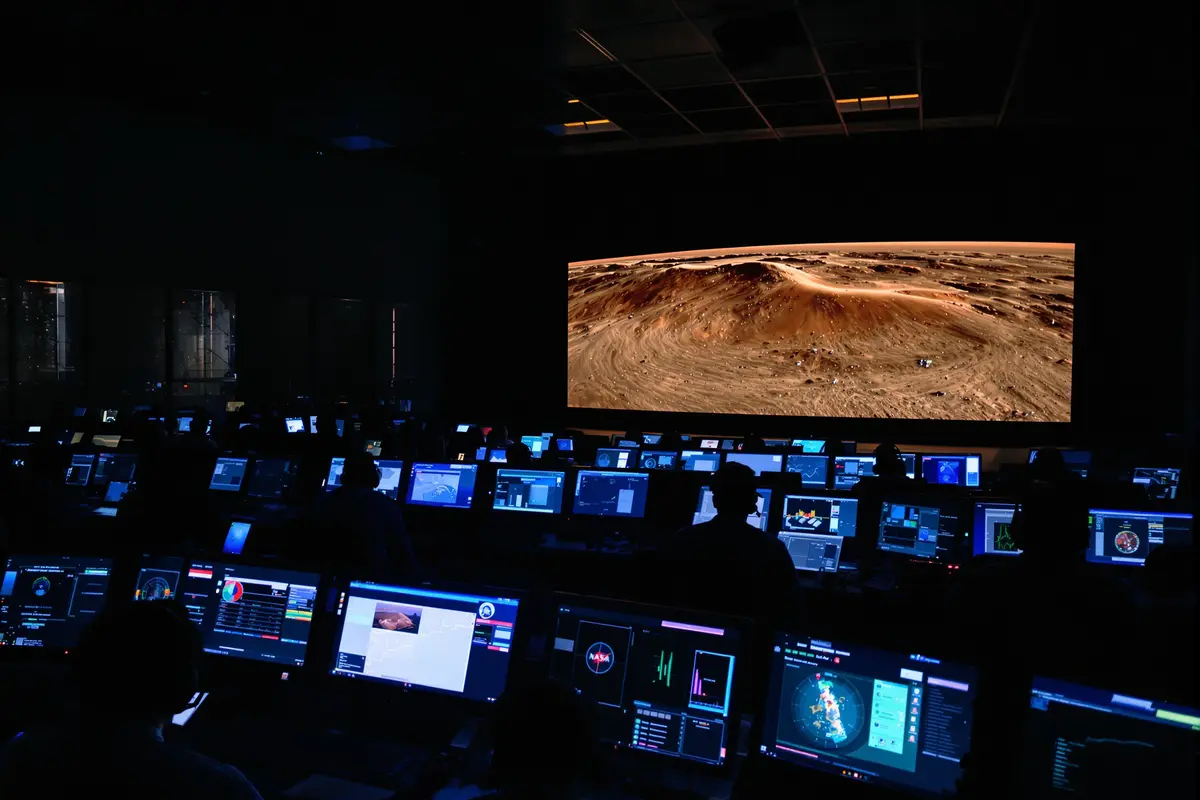
NASA engineers and astronauts working with rovers like Perseverance often shift their schedules to match Mars time. That means waking up late, eating “lunch” in the middle of the night, and drifting farther away from your usual life rhythm.
In just one week, your sleep and work cycle could shift by nearly five hours. After a month, it’s completely out of sync. This is what scientists call “living on Mars time,” and it’s more than just a quirky detail—it affects how teams plan, rest, and function during missions.
Einstein was right: gravity changes your clock
Albert Einstein’s general theory of relativity says that time is not fixed. It stretches and bends based on gravity and speed. On Mars, the gravity is weaker and the planet moves differently around the Sun. So, clocks there tick ever so slightly faster than identical ones on Earth.
The difference is tiny — you wouldn’t notice it day to day — but over months and years, it adds up. This matters because space missions demand extreme precision. Navigation can drift by meters or even kilometers if time is measured incorrectly. That’s the difference between landing on safe ground or crashing into a crater.
Tech and teamwork need a shared clock
You can’t explore Mars with everyone running on different timelines. That’s why space agencies are proposing a “Mars time standard”. Think of it as a Martian version of Coordinated Universal Time (UTC).
This standard will help coordinate:
- rovers
- orbiters
- bases
- drones
Without it, one mismatched time setting could crash a mission or delay an emergency response.
Engineers are also testing tools that convert Earth and Mars time instantly. Algorithms now include these tiny time warps from the start, because waiting until later can mean disaster.
For astronauts, time becomes a health challenge
The 24h39m schedule stretches your built-in body clock. Our circadian rhythms — the daily patterns that control sleep — expect Earth’s cycle of light and gravity. Mars throws that off.
Researchers are already testing ways to help:
- Smart lighting that mimics Martian sunrises and sunsets
- Planned wake-up and meal routines to guide the body
- Even medications to shift the internal clock safely
Some experts suggest using a “hybrid time” system. Inside the habitat, astronauts stick to Earth time to sleep and eat. Outside, they adjust for Mars time when working with rovers or collecting samples.
Either way, the impact on physical and mental health is real. Long missions will need strong habits to avoid sleep loss, mood struggles, and slow reaction times.
Training astronauts to think in Einstein’s world
Future Mars crews won’t just learn engineering or biology. They’ll learn relativity like you’d study the weather — not as theory, but as something that changes your job day to day.
Missions planners already prepare for these shifts by:
- Building time corrections into navigation and communications
- Designing new scheduling software
- Modeling how tiny time differences affect landing windows and fuel use
In deep space, even small mistakes have big consequences. That’s why time is now treated as a crucial resource — just like water, energy, or oxygen.
What will time feel like for future settlers?
If people ever live long-term on Mars, time there will reshape everyday life. Kids born on Mars will celebrate birthdays that last 39 minutes longer than yours.
Work schedules, holidays, even TV shows will feel just a bit off. Time zones might follow craters and canyons instead of continents, and calls home to Earth will never quite feel in sync.
The more we explore, the more our once-shared sense of time starts to split. Relativity won’t stay in physics textbooks. It will show up at dinnertime, in meetings, and in how we plan our futures.
FAQ: What you need to know about time on Mars
Does time really pass differently on Mars?
Yes, but only slightly. Mars’ weaker gravity and motion make clocks there tick a tiny bit faster than on Earth. It’s a real effect predicted by Einstein’s relativity — and missions already account for it.
Is that the same thing as the longer Martian day?
No. The 24h39m sol comes from Mars spinning slower. Relativity is a separate effect related to gravity and speed, not rotation.
Will astronauts feel the difference?
They’ll feel the extra 39 minutes each day, which can mess with sleep and focus. The relativistic time shift is too small to feel directly but shows up in data and planning.
How do missions deal with the time shift now?
Rovers use local solar time, and mission teams often adjust their schedules to match. Software constantly translates between Earth and Mars time to keep things on track.
Will Mars settlers follow a different calendar?
Likely, yes. Scientists are working on calendars based on sols and local times. But they’ll still coordinate with Earth’s calendar for communication and updates.
On Mars, time doesn’t follow our rules. It’s longer, it flows differently, and one day, it might define a whole new version of human life. That strange tug at sunset on another planet? That’s the future, ticking in a different rhythm.